Everyone quotes you the licence fee. Nobody quotes you the number after that.
A cloud kitchen in Dubai doesn't fail because the trade licence was expensive. It fails because the owner budgeted for the licence and forgot the other lines sitting underneath it.
This is a walkthrough of those lines, in the order they hit your bank account.
There's no such thing as a cloud kitchen licence
Clear this up first, because it trips up almost every new operator.
Dubai does not issue a dedicated "ghost kitchen" or "cloud kitchen" licence. There is no separate category for it.
What you actually need is a regular F&B trade licence from DET or from a free zone, a Dubai Municipality Food Establishment Permit, and FoodWatch registration.
"Cloud kitchen" is just a name for the operating model: delivery-only, no dine-in. The paperwork underneath it is the same paperwork any food business files.
Why this matters for your budget
There's no dedicated category, so there's no dedicated flat fee either. What you pay depends on where you set up, what bundle you choose, and how many components you're stacking.
The licence bill, broken into its parts
Mainland setups tend to land in the AED 16,000 to AED 25,000 range for the combined trade and food licence package. That range hides several separate charges:
- Mainland trade licence from DET: AED 10,000 to AED 15,000, covering name reservation and initial approval
- Food Establishment Licence from Dubai Municipality: AED 5,000 to AED 8,000, covering inspection and HACCP review
- HACCP certification itself: AED 3,000 to AED 5,000
- Staff visas and health cards: AED 3,000 to AED 5,000 per person
- Kitchen layout approval: AED 2,000 to AED 4,000
Free zone packages run wider, AED 12,500 to AED 30,000, because it depends entirely on which bundle you pick.
None of these are government tariffs published on a fee schedule. They're consultancy estimates, gathered from firms that process these applications regularly. Treat them as a planning range, not a fixed invoice.
Rent is where shared and dedicated space split hard
This is the number that actually decides your monthly survival, and it varies more than the licence does.
Shared or pod kitchens
If you lease a slot inside a shared facility, that facility already holds the master permits. You're renting capacity, not building a licensed kitchen from zero.
- Typical pod lease: AED 5,000 to AED 15,000 per month
- One independent Dubai listing advertised rent from AED 8,000 per month, location dependent
- That same listing charged a 10% agency commission on the annual rental value, payable on signing
Dedicated, single-brand kitchens
If you want your own licensed unit rather than a shared pod, monthly rent for dedicated space can run up to AED 20,000. The all-in setup cost, covering licence, fit-out, rent during setup, visas, and a working buffer, can land anywhere from AED 80,000 to AED 150,000.
The gap between a pod and a dedicated unit isn't small. It's the difference between subletting a fitted slot and building a food business from bare shell.
Fit-out and equipment: the line people underestimate
Even inside a shared kitchen, you're not walking in with nothing. Ovens, refrigeration, small ware, extraction-compatible equipment. It adds up fast.
- Equipment and fit-out: AED 50,000 to AED 100,000, depending on cuisine and volume
- Utilities and maintenance: AED 3,000 to AED 6,000 per month, ongoing
A kitchen that already has extraction, fire suppression, a gas connection and drainage in place removes one whole category of spend before you've plated a single order. Most new operators price for this and then find out they still have to install it.
Then the platforms take their cut
Licensing and rent are one-time or monthly. Platform commission hits every single order, forever, and it's the number that quietly decides whether a busy month is a profitable one.
Talabat
Independent and cloud-kitchen operators typically report 25% to 30% commission. High-volume chains negotiate down to 18% to 22%. Add 2% to 2.5% payment processing on card transactions.
A 2021 Dubai Restaurants Group membership deal offered 5.3% commission plus an AED 8.40 flat delivery fee for qualifying members. That was a capped, time-limited programme, not today's standard rate.
Deliveroo
Reported commission runs 25% to 35% per order. An onboarding fee applies at sign-up, on top of the ongoing commission. It currently operates across Dubai, Abu Dhabi, Sharjah, North Sharjah, Al Ain and Ajman.
Noon Food
This is the cheaper option, at roughly 21% base commission. Add about 2% payment processing, for a combined effective rate near 23%.
A separate 5-year graduated structure for Emirati-owned F&B SMEs starts at 10% in year 1 and rises to 20% by year 5.
Keeta
Keeta is the newest entrant, live across all seven emirates by late 2025. Commission rates aren't public. Its Founding Vendor Program waived setup and registration fees for early partners, with priority placement during launch.
What this does to your margin
Stack it up. Licence, rent, fit-out and utilities are the cost of existing. Commission is the cost of every order you actually take.
A dish priced to clear cost on paper can lose 25% to 35% of its value to a single platform before payment processing is even added. Running three platforms at once means three different commission structures against the same menu. VAT registration becomes mandatory once annual turnover passes AED 375,000, adding another compliance layer once you're past that point.
None of this means delivery-only doesn't work. It means the margin has to be built for the commission that's actually charged, not the one you hoped for.
Where the infrastructure argument comes in
Much of the AED 50,000 to AED 100,000 fit-out estimate above is extraction, fire suppression, gas and drainage: the physical build that has to happen before health and safety will even sign off your layout approval.
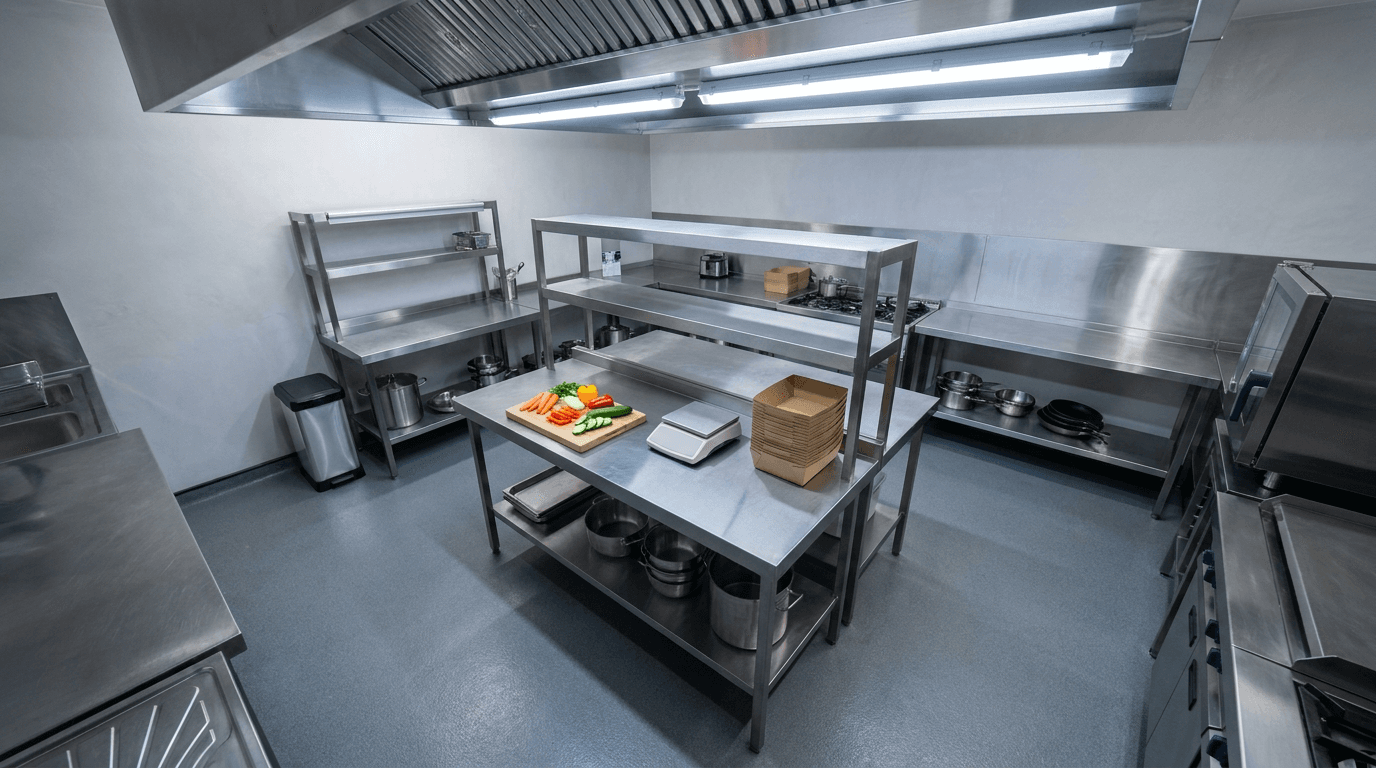
A kitchen unit that already has extraction, a fire suppression system, a gas connection and drainage fitted removes that build entirely. You're not pricing scaffolding and ductwork. You're pricing a fitted unit you can walk into.
What to actually check before you commit
Before signing anything, get real numbers on:
- Which licence components are already included versus billed separately
- Whether rent is quoted monthly or annually, and whether an agency commission applies on top
- What each delivery platform's current commission actually is for your order volume, not the headline rate
- Whether utilities are metered separately or bundled into rent
- What the total move-in cost looks like once fit-out, visas and a working buffer are added to the licence fee
Where Basta Amore fits into this math
Basta Amore sublets small fitted delivery kitchens inside DAMAC Voleo, The Vogue, in Business Bay. Each unit is 9 to 13 sqm, already fitted with extraction, a fire suppression system, a gas connection and drainage.
That's the fit-out line from the section above, already done.
There's no published price list here, and no online checkout. The only way to know what a unit actually costs to run inside this building is to walk through one, see the extraction, check the gas connection, and ask the questions above in person.
The next step
If the commission math above changed how you're thinking about margin, see the space itself before you sign anything.
Book a viewing through Basta Amore's WhatsApp channel, walk the unit, and bring your platform commission numbers with you. That's where the real conversation about cost happens, not on a page, but in a room you can walk into.