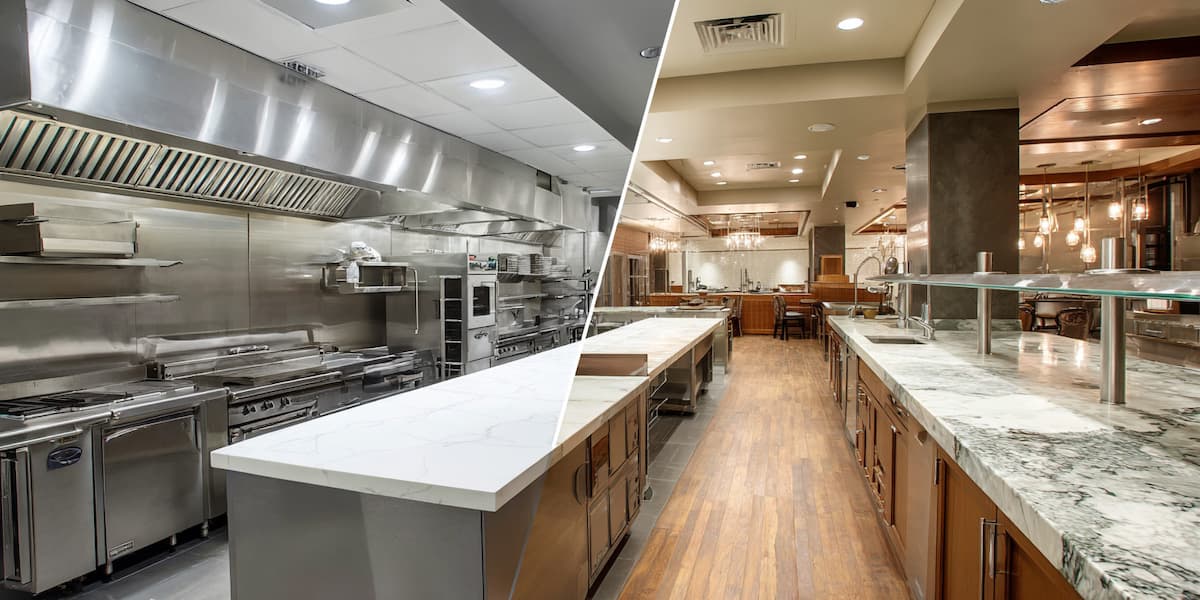
The same question, asked before you sign anything
Every Dubai food business starts with one decision that shapes everything after it.
Do you rent a delivery-only kitchen and reach customers entirely through apps, or do you open a room with tables and build something people walk into.
Both are real businesses. Both can work. They commit you to almost opposite things.
This isn't about which is better. It's about what you can afford to commit right now, in space, staff and time.
What a delivery-only kitchen actually is
A cloud kitchen has no dining room and no front of house. There is no walk-in trade.
Every customer arrives through a delivery app. Nobody passes your door and decides to come in, because there is no door to pass.
In Dubai, there's no separate licence category for this model. Cloud, ghost, dark and "virtual restaurant" are the same delivery-only setup under different names, running on a standard trade licence with the right food activity code plus a Dubai Municipality food establishment permit covering layout, HACCP plan and inspection.
What's genuinely different about this model is what one permitted kitchen can carry:
- One licence, one kitchen, one team
- Three to five separate virtual brands running at once
- Each brand with its own name, its own menu and its own listing on the delivery apps
- A failed menu replaced without moving anything
What a dine-in restaurant actually is
A restaurant sells something a delivery box can't carry: a room, service, a reason to come back.
It earns from three channels at once, dine-in, takeaway and delivery, where a delivery kitchen earns from one.
It's visible on the street. People build a relationship with a restaurant by walking past it, by sitting in it, by being served by the same face twice.
It also carries cost layers a delivery kitchen never touches:
- A dining room, front of house staff and service to run every night
- A fit-out that is a separate, much larger commitment than licensing
- A liquor licence if alcohol is part of the plan, with its own annual renewal
- A valid RTA food delivery permit if it delivers as well, renewed every year
Why this comparison matters in Dubai specifically
Dubai orders delivery heavily. The UAE food delivery market is growing at roughly 10% a year, and is tracked to reach about two and a half times its 2024 size by 2033, according to IMARC Group figures reported UAE-wide.
That behaviour already exists. A delivery-only kitchen is built to meet it directly, with no footfall to create first.
Talabat alone is reported to hold 76% of Dubai's food delivery market, per the Dubai Department of Economy and Tourism's Gastronomy Industry Report. Deliveroo confirms it currently operates across Dubai, Abu Dhabi, Sharjah, North Sharjah, Al Ain and Ajman, and runs its own delivery-only kitchen concept, Editions, with sites across the city.
That scale cuts both ways. The apps that hand you customers also own the relationship with them.
What renting a cloud kitchen commits you to
The commitment is small, and that's the entire point of the model:
- A single fitted room, not a building
- No front-of-house headcount to hire, train or roster
- A short runway to first order, measured in weeks rather than months
- A licence route that moves faster through a shared kitchen provider than an independent setup
- An exit that doesn't involve breaking a long retail lease
It's the format built for testing a concept before committing more than that.
What renting a cloud kitchen costs you
The cost is dependence, and it shows up in three places:
- The apps own the customer relationship, not you
- Every order pays a commission before anything else is counted
- Visibility inside a crowded app listing is bought, not walked past
Commission rates aren't published on a fixed public card by any major platform. What's on record is a mix of dated, narrow examples: a 2021 group-negotiated Talabat tier limited to the first 500 qualifying Dubai Restaurants Group members, and 2020 pandemic-era press quotes citing aggregator commissions as high as 35%. Neither should be read as a current standard rate for a new operator. Treat any number you hear from a platform rep as a starting point for negotiation, not a fixed cost.
What opening a restaurant commits you to
A restaurant asks for a different kind of commitment, one measured in years, not weeks:
- A location signed under a lease you're tied to for its full term
- A dining room built and decorated before a single cover is served
- Full front-of-house and back-of-house staffing, every service
- Ongoing utilities, maintenance and repairs on a space you can't easily downsize
- A slower approval path, since fit-out, food safety permits and possibly a liquor licence all stack before opening day
That's a heavier structure to carry, but it's also the only one of the two that builds a business people can walk into and remember.
What opening a restaurant gives back
The upside matches the commitment:
- Three revenue channels working at once, not one
- A physical presence that markets itself to everyone who walks past
- Relationships built face to face, which an app listing can't replicate
- No dependence on any single platform's commission structure or algorithm
The two are not exclusive
Starting in a delivery kitchen and opening a room later is a sequence, not a compromise.
A concept can be tested at low commitment, proven against real orders, and only then moved into a space with a dining room, once the menu and the demand are both known quantities.
That order of operations is exactly what a delivery-only kitchen is for.
Where the licensing detail actually bites
Getting the licensing structure wrong is the expensive mistake in either direction.
Both models sit on the same two-track structure in Dubai: a DET trade licence with the correct food activity code, and a Dubai Municipality food establishment permit. A cloud kitchen setup can move through approval in weeks via a shared kitchen provider. An independent setup, or a full restaurant fit-out with its extra permit layers, takes considerably longer.
That timeline difference is often the real decision point, more than any other single factor.
What actually decides which one fits
The honest version of this decision comes down to three questions:
- How much capital can you commit before a single order ships
- How much of the customer relationship do you need to own directly
- How long are you willing to be tied to one lease, one space, one build
A delivery-only kitchen answers all three with less: less capital, less ownership of the customer, less time tied down. A restaurant answers all three with more, and with more comes a business that can be seen, walked into and returned to.
Neither answer is wrong. Only one of them fits what you can commit right now.
Seeing a fitted kitchen before deciding anything
Reading about commitment levels only goes so far. A fitted, permit-ready kitchen looks different in person than it does on a page.
Basta Amore is delivery kitchen space inside DAMAC Voleo, The Vogue, in Business Bay. Each unit is 9 to 13 sqm, already fitted with extraction, fire suppression, a gas connection and drainage in place.
There's no online checkout and no reservation. The only way to know if a unit suits your concept is to walk into one.